


Turcot: A Reconstruction Proposed by beewoo
Fascinated by concrete and architecture, Bérengère L. Marin-Dubuard, also known as beewoo, created a faithful model of the Turcot interchange in the form of an interactive construction game inside the Satosphère. Until June27, as part of the Biennale d’art numérique, visitors can see the work Turcot: Laroute devenue architecture free of charge at the SAT. I had the opportunity to experience the piece and to speak with Bérengère

design and production of the interchange.
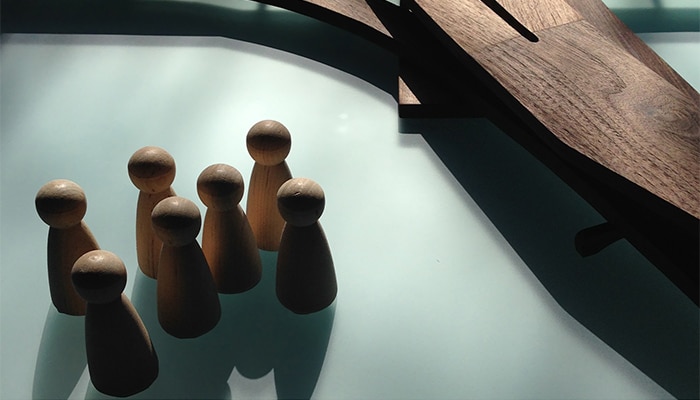
Turcot: La route devenue architecture is an interactive work in the form of a huge round table. The current interchange is presented with dark brown walnut-wood pieces on a polished glasstable. The construction is located in the SAT dome, the Satosphère, which allows spectators to be almost completely immersed in the projected environment of the interchange. Small figures resembling chess pawns are placed around the table. When these small characters are placed on the table, they change the landscape projected in the Satosphère and therefore alter the spectator’s point of view. On three side tables, many lighter pieces of wood are available. These pieces represent the reconstruction of the interchange, which visitors can arrange as they wish. By placing these new pieces on the table, they appear in the setting of the current interchange to form an invented new construction.
In meeting Bérengère, I gained access to the whole history of a work that may seem simple at first but is in fact the result of seven years of research, construction and development. At the beginning, Bérengère’s interest in the Turcot interchange came from its composition, design, complexity and photographic qualities. Through her work, the artist questions the mysterious way in which engineers imagined and planned the interchange’s roads. This reflection, begun in 2007, led her to photograph the structure and then learn about its planned reconstruction. After reading
many reports from
the BAPE, the Turcot interchange became for Bérengère both an art project and a research project.
The research beganwhen her art project quickly led her to deepen her work at the TAG research centre, Technoculture, Art and Games. This centre, focused on the study ofvideo-game creation, design, digital culture and interactive art, enabled Bérengère to meet MohannadAl-Khatib,
a digital and 3D artist and graduate of Concordia University’s Computation Arts program. With the TAG research group, she was able to refine her research on interactivity and play, which helped her make decisions about the type of gesture participants should perform to interact with the structure. She wanted to create a mixture between a construction game and a game of chess or checkers, so that the installation would be both a multiplayer social game and a game that lets participants build a form, like a children’s game, involving the touch of an organic material: wood.
Through this research and Mohannad’shelp in positioning photographs on the 3D model of Turcot, Bérengère realized the complexity of the operation. Modelling involves designing a 3D model based on a real model. This crucial step would allow her to make new interchange pieces appear in the current documented photographic setting


of the known structure.
At that point, solutions emerged through several brainstorming sessions with the Metalab team, Daniel Naud’s expertise and grants from the Canada Council for the Arts and the Conseil des arts et lettres du Québec. The two arts-council grants allowed Bérengère to deepen her research within the SAT’s Métalab research centre and to benefit from the knowledge of a whole team. Daniel Nault, a geolocation specialist, alsohelped her develop positioning tools essential to the project’s success. From photographs taken by Bérengère with a very high-definition digital camera equipped with a GPS system, Daniel was able to retrieve all the geographical information and turn it into clear databases.
When someone places a small figure on the table, a geographical point is detected by the SpinFramework system,created by programmer Mike Wozniewski as part of the Métalab. The system makes the figure travel from one point to another. This journey is visually perceptible through changes in the photographs within the Satosphère. In this environment, each point in the universe is catalogued by 24 photographs taken by Bérengère, forming a 360-degree overview for each point on the table. These photographs are found in the SpinFramework environment. When Bérengère arrived at the SAT, the software was not entirely finished, but it represented an open-source solution for making the work function. David Duguay, developer and researcher at the Métalab, therefore developed the system so

that Turcot could run on it. Under thesmall figures are fiducial markers. These markers, which resemble little black-and-white cell drawings, allow a camera under the table to read the figure’s position through the drawing on its underside. Fiducial markers do not yet have limits because of their open-source condition. This situation allows anyone to develop the potential of the Reactable system according to their taste and to share their discoveries with the online community. For example, in the video below, during a live session organized by Reactable, a DJ uses the system as a
[youtube id=”Y2YeMbIiGho” width=”640″ height=”360″ autoplay=”no”]
sound-creation console. More specifically, Emmanuel Durant, who developed the programming for the Reactable table, was able to know where each character was located
in a 3D environment.
Turcot: modelling and construction. Each new piece of the Turcot interchange had to be modelled in 3D and then textured from Bérengère’s photographs. At first, the artist wanted to do everything with photos to give the appearance of a constructivist collage, which suited the fact that the Turcot interchange was falling into ruin. However, the process was too complex and she had to abandonthat approach. Several software programs were used before reaching the final result:Blender3D, an open-source program; Google’s Sketchup, which made the first sketch of thesatire possible; and finally the company dix2, which modelledeverything in Solidworks.Dix2 modelled the wood pieces and built the central table. The models were then sent to Robotcut Studio, which created the wooden pieces from the sketches.
Sound is important because it suggests that the more road is added to the structure, the more noise there is, encouraging visitors to remove roads rather than add them. Visually, however, one is tempted to add roads in order to create graphic compositions. There is a tension between what is perceived visually and sonically: we want to see more road, but we probably want to hear fewer cars. Through this, the artist seeks to evoke the well-known urban-planning phenomenon of induced demand: the more lanes are added to highways leading to the suburbs, the more the suburbs grow and the city empties out, and the more traffic and congestion appear on the highways. The induced-demand factor is exponential. The sound aspect of the project was created by Julian Stein in Pure Data, another open-source software.
Thevisible 3D models are based on dix2’s models, reworked in 3ds Max byPedro,a modeller and 3D developer. Pedro then refined all the models by adding details such as lampposts and texture. Each stage of the project required testing,

research and development to reach the final result. In its conceptualization and production phase, the project represents about seven years of work. It was supported by the Conseil des arts et des lettres du Québec, the Canada Council for the Artsand the Technoculture Art and Gamesresearch centre. It was developed during a residency at the SAT, in collaboration with the Métalaband as part of BianMontréal.
Similar posts
Culture and Creativity
read the article
Discover the MAËSTRO in You!
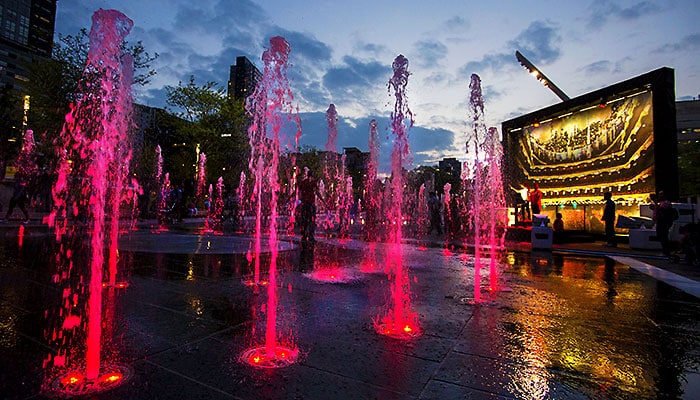
Great musical airs can be heard in the Quartier des spectacles thanks to MAËSTRO, ATOMIC3’s interactive installation. Since May 14, Montréal’s Quartier des spectacles has allowed visitors to become conductors of its outdoor fountains through the...
Culture and Creativity
read the article
Call for Participation: Mois Numérique Jeunesse 2022
Montréal, November 22, 2021 — For the third edition of Mois Numérique Jeunesse, Printemps numérique is joining forces with partner organizations committed to digital citizenship, literacy and access for young people. The call invites...