


LUNGTA: Breath as a Source of Inspiration
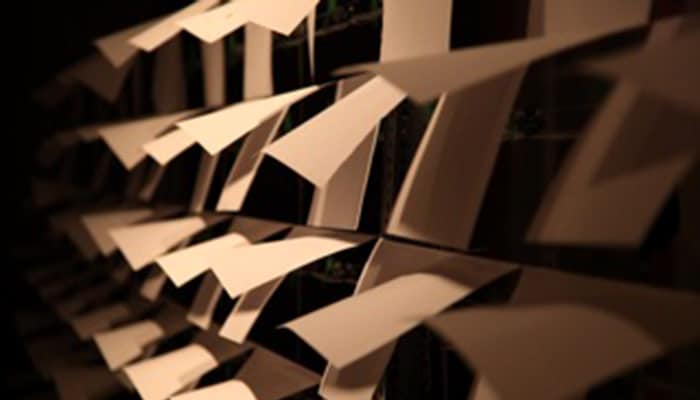
As part of the 2014 Biennale d’art numérique(BIAN2014), Patrick Saint-Denis presented his interactive work LUNGTA at the Maison de la culture de Pointe-aux-Trembles. The piece is inspired by the multicoloured rectangular fabric garlands suspended on mountain passes and summits in the Himalayas, Tibet, Nepal, Sikkim and Bhutan. Drawn by the lightness of the work and its connection to wind, I contacted Patrick to learn more. What initially seemed like a very simple piece turned out to be an artistic creation with many facets.
First, let us look at how the work was presented during BIAN2014. In the form of a wall covered with small white paper squares, the wall called LUNGTA reacted to the presence of people in the room. Equipped with 192 motors hidden behind the paper squares, it blew wind according to people’spositions. Detection, managed by a Kinect, allowed Patrick to know exactly where the spectator was in the room and then send that datato small motors controlled by an Arduino. If a person moved from left to right in front of LUNGTA, the work triggered a wave of wind in the same direction.
This detection system is indeed managed by the Kinect, but the code behind it comes

from Patrick Saint-Denis himself through a system he named
Kinki. In the author’s words, Kinki, or Kinect Interface Kreative, is an openFrameworks application based on the OpenNI, NITE and SensorKinect libraries. The application is a graphical interface that facilitates the design of a three-dimensional space. It allows interactive zones to be defined and associated with different parts of performers’ bodies. It uses the OSC data protocol so that performative gestures can be linked to a sound or visual creation environment.
Another program written by Patrick in C++ receives data from Kinki and triggers patterns; it is a kind of intermediary software that he called lungta_wallDebug. He uses only custom software made for his projects, along with toolkits to build them. Heuses openFrameworks and, for sound, SuperCollider. It is very important to him that his tools be open source, and just as important to give back to the community. When he creates tools worth sharing, he does so either as software or by making his sources accessible, allowing people to download his code for their own projects. The sources for Kinkiare available on his GitHub profile.
To understand this rich process more clearly, the video below shows LUNGTA in a cultural-mediation project in which a group of
[youtube id=”5K9tRukDnUo” width=”640″ height=”360″ autoplay=”no”]
children play with the work. The intended result is an abstract moving image in relation to music. Patrick speaks here of physical visual music when he interprets this type of presentation with LUNGTA. In this case, the screen is a physical screen with a low resolution of 192 pixels, on which images, especially graphic compositions, can be projected. He developed compositions so the wall would react to a camera. He interacts with the camera at the end of the video, but he would have needed twice or even three times as much paper to have enough resolution to see facial details as on a real screen.
LUNGTA is therefore an interactive project in which choices were made regarding detection systems and programming. To achieve it, Patrick Saint-Denis had to conduct many tests at the Université de Montréal, which brought the project into other universes that, at that stage of design, had not been anticipated. LUNGTA, as presented at BIAN2014, was very similar to the original design created at UdeM. The video below shows Patrick’s research on the detection system:
[vimeo id=”33354111″ width=”640″ height=”360″ autoplay=”no”]
he first interacts with various shapes, then with his face and hand.
At the heart of Patrick’s motivation is the audio-reactive aspect of the project. He began working with objects that reacted to sound and realized that he could enrich the movement vocabulary of objects by using the same object many times. With LUNGTA, in robotic terms, the fans are quite simple, in a way wind dimmers, but because there are many of them he can create complex group movements from simple objects.
This is why LUNGTA was first interpreted using a microphone and flutes that transformed wind into visual forms. Here is a multidisciplinary audio performance of LUNGTA created with Geneviève Déraspe, Guy Pelletier, Michèle Motard and Patrick Saint-Denis himself: https://vimeo.com/53384500.
LUNGTA was then interpreted in a dance show entitled trois paysages, which toured Québec. The interactions are once again performed with a Kinect, as in the BIAN2014 model, but this time it detects dancers on stage. They dance with the wall in the choreography until it begins to move itself in order to seek out someone from the audience. How? The wall has small wheels that allow it to close in on itself, forming a kind of box, and to move around the stage while the dancers dance around it. The box then fetches someone from the audience and brings that person onto the stage. The work was created by Danse K par K with choreographer Karine Ledoyen. The studio visit by Tangente, thecontemporary movement laboratory, explains very well the origin of the fusion between LUNGTA and Danse K par K, as well as the essence of the work
[youtube id=”7npLyfr59zY” width=”640″ height=”360″ autoplay=”no”]
trois paysages.
In the end, LUNGTA is a project still in development, evolving and experimenting with breath, dance, movement and various forms of physical relationship. Patrick is currently working on VERTEX PROJECT, a collaboration with composers Jean Piché and Zack Settel. The project consists of mobile Leslie speakers; the first prototype is a single unit, but the project plans for 81 units on a 9 x 9 matrix. To follow Patrick Saint-Denis’s creations and research, visit his website: www.patricksaintdenis.com. Upcoming performances by
the artist: Offcinars, Trois paysages, November 2014; Montréal Nouvelles Musiques, Lungta, February 2015; Mois Multi, Lungta, February 2015, to be confirmed.
Similar posts
Culture and Creativity
read the article
Discover the MAËSTRO in You!
Great musical airs can be heard in the Quartier des spectacles thanks to MAËSTRO, ATOMIC3’s interactive installation. Since May 14, Montréal’s Quartier des spectacles has allowed visitors to become conductors of its outdoor fountains through the...
Culture and Creativity
read the article
An Ode to Nature at the Sight + Sound Festival
Eastern Bloc, through its Sight + Sound festival, never stops surprising us with the originality of its invited artists. Intriguing and disorienting, the event welcomed two renowned artists with diametrically opposed styles on May 21: Rie...