


intersections VOL.2: Artificial Intelligence
Artificial intelligence raises major issues.
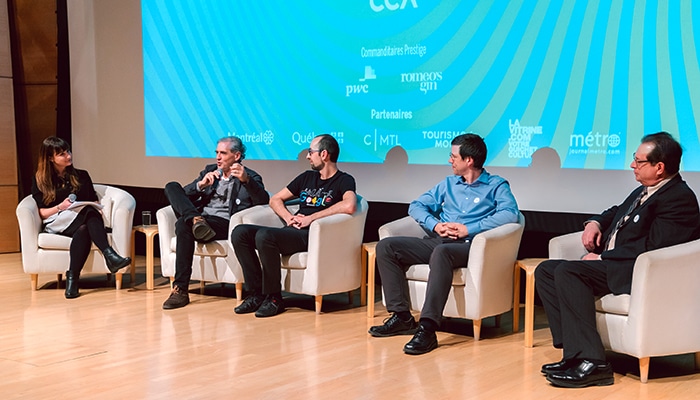
It is a catalyst for fear and change, a vector for countless possibilities, and we still struggle to imagine the deep transformations it will continue tobring in the years ahead. The #intersections vol.2 evening on March 7 highlighted issues raised by this essential component of digital innovation. Creators, entrepreneurs and managers from many fields attended, notably to hear Hugues Bersini, professor at the Université libre de Bruxelles. A charismatic popularizer, Bersini is the kind of speaker who can make differential calculus sound exciting. In a packed room at the Canadian Centrefor Architecture, he appeared with three other speakers:GheorgheComanici, developer for the Google Chrome browser; Guillaume Chicoisne,directorof IVADO; and Dr. Jeffrey Goldstein from IBM’s Watson Centre of Competence. Preaching optimism and the good news of artificial intelligence, Bersini firmly believes that this technology can be a tool humans put to work for themselves. He cited centaur chess teams, made up of humans and computers; some of the greatest players, once defeated by machines, found that the confrontation made them better because it forced them to think of tactics they would not have considered against a human opponent. Dr. Jeffrey Goldstein described the positive advances AI brings to medicine. To keep up with every new breakthrough in health, a doctor would need to read 29 hours a day, animpossible task. Watson, IBM’s artificial-intelligence program, can analyze X-rays in real time and suggest a diagnosis. It is not a doctor, but an adviser, a useful partner. Artificial intelligence therefore appears as a tool whose harmful or beneficial use depends on the intentions of those who use it. Bersini is less concerned with disaster scenarios than with governments’ loss of control. He argues that GAFA, Google, Amazon, Facebook and Apple, concentrate some of the best minds on the planet, acquire patents and appropriate technologies while governments stand by. These companies are at the forefront of social transition, he said, not our leaders. Governments must regain control over the immense power private companies
have acquired. Photo album and eventwebsite
Similar posts

Culture and Creativity
read the article
Digital Archaeology: Last Chance!
The Canadian Centre for Architecture trilogy ends on Sunday. Under the theme Complexity and Convention, the exhibition Archaeology of the Digital features 15 pioneering projects...

Culture and Creativity
read the article
2,000 People Were at the McCord for the Launch of Printemps numérique
Who said digital creativity was niche? Throughout last Thursday evening, 2,000 visitors gathered at the McCord Museum for the launch of the fourth edition of Printemps numérique under the theme Montréal Fashion...