


effectsMTL: Atomizing Cairo
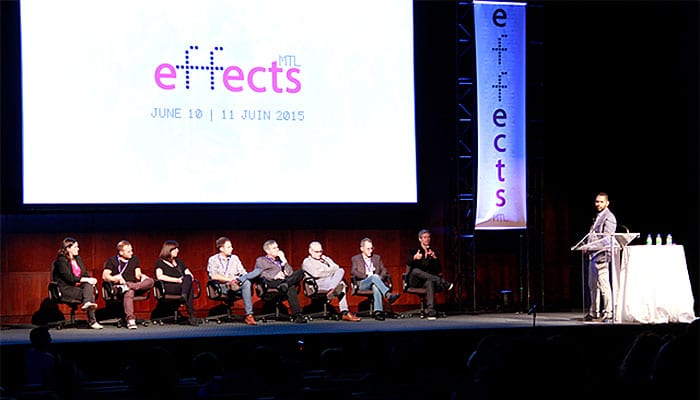
On June 1 and 2, effects MTL, the largestinternational visual-effects and animation conference on the American East Coast, was held. A quick look
at effects MTL. For
two days, the Palais des congrès de Montréal hosted some of the most influential players in the field of visual effects. To reach the standards Hollywood has accustomed us to, the art of special effects requires the equivalent of thousands of hours of work and staggering sums of money. By examining sequences only a few seconds long, one could grasp all the resources needed to create them. During the conference, dozens of booths also presented the latest work by software companies such as Maxon, as well as visual-effects and 3D-imaging programs from certain Québec educational institutions: Université du Québec en Abitibi-Témiscamingue (UQAT), Cégep de Jonquière, Centre de recherche et développement en imagerie numérique de Matane and others. While effects MTL could serve as a springboard toward a job in the field for artists, it was also an opportunity for the general public to examine the breathtaking or futuristic scenes of blockbusters such as X-Men Apocalypse and Deadpool.By talking with the people responsible for the special effects for Suicide Squad or ExMachina, the public could become familiar with the work of talented artists. It is still a source of pride to say that Québec is a hub for visual effects (VFX) and animation, and that the region ranks 4th in the world in this field.
X-Men Apocalypse: behind the scenes of a
sequence. One of the must-see events of this edition of effectsMTL was certainly Tuesday’s conference on a particularly impressive scene from the latest X-Men, released on
May 27. The film,
in short: the villain Apocalypse awakens from a sleep of several millennia and decides to remake the world in his own way. Among his henchmen are four mutants, including Magneto, the iconic X-Men villain. Able to attract and repel any form of metal, he manages to atomize the city of Cairo, Egypt, and reuse the metals to form a pyramid in the centre of the destroyed city. Easier said than done. With Jerome Escobar and Joan Panis from MPC, a Montréal giant in visual experiences, and Matt Sloan of 20th Century Fox, we learned more about this absolutely epic sequence, which required more than sixty days of shooting and nearly eight months of postproduction work. Architecture of destruction. To create a credible replica of
the city in 1983,
the year in which the action takes place, they built a library of thirty model buildings. After determining how the buildings would react to light if they really existed, they consulted interior-design specialists to establish the position of pillars inside these virtual buildings and set up variations of collapse. Once the library had been expanded to 700 buildings in different states of destruction, the visual effect of Cairo’s disintegration had to be integrated, turning stone from debris to dust to smoke. The same had to be done in reverse to create the great pyramid. The result: in a single frame, and a film contains 24 per second, there can be 80 million particles. This event alone made me want to return to the extraordinary universe of X-Men. As proof, I watched three films from the saga after writing this post. In short, after this first experience, I admit I am very enthusiastic about taking part in a future edition of effects MTL. I cannot wait to discover in greater detail all the richness this kind of initiative has to offer.
Similar posts
Culture and Creativity
read the article
2020 Program: Registration Is Now Open!
The spring season is approaching, and organizations are invited to submit activities taking place between March 21 and June 21, 2020, for inclusion in the seventh season of Printemps numérique. Since 2014, Printemps numérique...

Culture and Creativity
read the article
Québec Cohort Sought to Take Part in Printemps numérique Brussels!
Montréal, January 27, 2020 — Printemps numérique has always believed in the richness of collaboration and in sharing knowledge among communities. In that spirit, it is offering Québec digital companies an opportunity to shine...