


A flight of renderings!
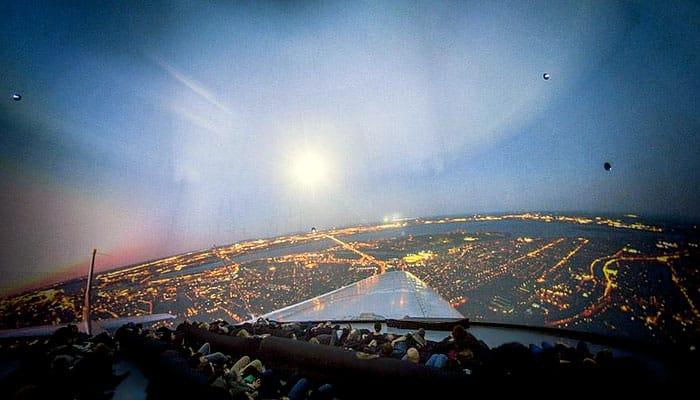
As part of the Satosphère’s new springimmersive program, I attended the premiere of Polynôme. This show is a compilation of four short films exploring new languages of immersive videocapture. Thefirst short film, Envol,by Christian Morissette, Alexandre Lanthier and Maxime Lortie, shows

the Wright brothers’ first flight transforming into multiple takeoffs.
The presentation did not remain at the level of a standard film projection. It was shown in the Satosphère, a fulldome projection environment that allows almost total immersion. Viewers lie on large cushions in a bowling-ball-shaped room, giving the impression of being surrounded by 360-degree projections. Christian Morissette explains that
the
goal of Envol was to demonstrate how far cinema can go today and what it may do in thenear
future.
How did the team push the limits of film? First came the shoot. Envol was captured in 360 degrees, which means, as Christian says, that you have to hide, often while running. This type of
shooting also forced the team to trust the takes, because they could not see on site what was being filmed. After thatchallenge came long hours of exporting before the team could access the footage.
The camera used was a Lady Bug, which captures 15 frames per second but produces jerky raw footage. The solution was to add a digital frame in After Effects between each of the 15 images to make the film

fluid and reach 30 frames per second. This filled the video gaps with images created in the software and camouflaged the jerky effect.
Previews in the software lasted onlyeight to ten seconds, which greatly limited the creators’ control. Each 4K by 4K image required hours or even days of rendering before it could be processed. Maxime Lortie explains that the astronomical rendering time required careful planning, especially for sound. They had to plan three to four days of rendering, including possible crashes, before sending a compressed render to the sound editor. Before any screening, at least eight to nine days were needed to finish thework. Envol therefore required 178 hours of rendering. Thanks to TeamViewer, the creators could control the renders remotely
and restart everything after the many crashes.
Finally, editing had to be done in a round image, like the Satosphère dome,

making it difficult tounderstand the final composition during room tests. The team had to identify errors as quickly as possible during the rare available screenings. Despite this, the creators achieved real visual feats, including a

wall of screens becoming an infinite tunnel. Technology offers endless possibilities, but it still requires patience and precision.
Similar posts
Culture and Creativity
read the article
Moeraki: Immersive Dome
I went to meet the team that will present the Moeraki installation during the closing evening of Printemps numérique: four people with very different strengths. Ourahou Abderrahman, a teacher...
Culture and Creativity
read the article
Call for Digital Projects: #intersections VOL.2
On Tuesday, March 7, 2017, Printemps numérique will present the second event in the #intersections / digital transformations series. This second volume will focus on artificial intelligence. Presented as a 5 à...