


Moeraki: Immersive Dome
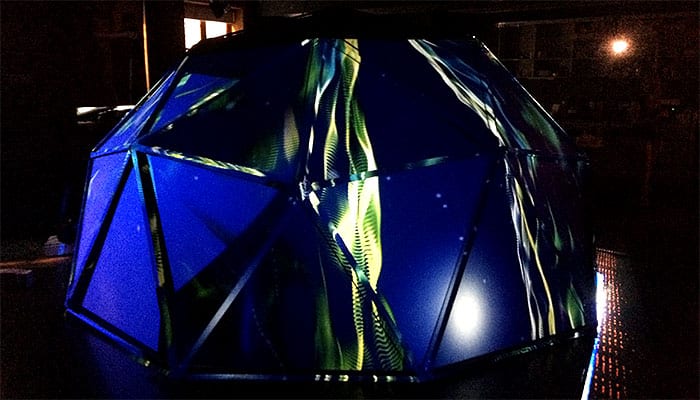
I went to meet the team that will present the Moeraki installation during the closing evening of Printemps numérique: four people with very different strengths. Ourahou Abderrahman, a teacher in the Interactive Media program at UQAM and founder of Pix Senses, took part in conceptualizing the project and building the dome, while helping the other team members with their respective tasks. Iriana Rakotobe handled the dome construction, technical direction and most of the dome mapping. Hélène Coupé produced the visual content inside and outside the dome. Vincent Cusson created the project’s sound content. The team behind Moeraki: Ourahou Abderrahman, Hélène Coupé,

Moeraki project? Several difficulties arose. First, one
of the most important was building the dome. We had access to very little equipment, which made the task harder to carry out. The budget for designing the dome was not very high, so we had to manage with our own means. We also spent a long time thinking about which software to use. We did not master the software we really needed, so we had to adapt and work hard to achieve quality with new tools. Mapping the dome was very complex because of its shape, and creating visuals for the inside of the dome was a major challenge. On the sound side, managing 5.1 sound, the various plug-ins, drivers and the sound card required careful thought. Why call it Moeraki? For the story. They are large rocks found only in
New Zealand, cracked rocks into
which you can enter and slide. We liked the name because it relates to the roundness of the dome, but also to the experience of entering the dome and being somewhat trapped there until the end of the performance. We spent a whole day finding the name. But when Abdel proposed it, everyone immediately connected with it. And what about the visuals? For the visuals, there are two tableaux. The first is relatively concrete and represents
the journey and the fall, which
is the basic idea. We begin in the sky and move farther and farther away from it until we fall into water. There is a surreal side, because once we have gone too far into the depths of the water, we find ourselves in space. The second tableau is more about depth and the idea of movement. We move a camera and play with the dome. Let us talk a little about sound now.
I do a lot of
sound for image. It is a concept of geophony. I want layering that recalls water. We also opt for complete immersion in the dome, as if one were underwater at the bottom. All of it is in 5.1. What type
of experience do you offer with
Moeraki? We want to immerse the spectator. What we would like is for something to react inside the spectator’s body. It has to be a sensory experience. We will add simulators to make the experience even
more complete. Why did you decide to present Moeraki at the closing evening
of Printemps numérique? We are partners of Printemps numérique through UQAM’s interactive media program. It also gives graduating students and interns good visibility thanks to the reach of Printemps numérique, and that is very rewarding for them. It is a large-scale project with many challenges to take up. It was a major first for us to create a dome. Now the next big challenge will be to rebuild it for the closing evening and especially to remap it. Totry Moeraki, come to the closing of Printemps numérique on June 21 at the Société des arts technologiques.
Similar posts
Culture and Creativity
read the article
Come Celebrate Indigenous Peoples
Press release for immediate distribution. Printemps numérique and the Conseil de la Nation Atikamekw present a youth digital event to mark National Indigenous Peoples Day. The initiative invites participants to celebrate Indigenous peoples while...
Culture and Creativity
read the article
The Imaginary Cosmoses of Sight & Sound
In a well-hidden building with an industrial look that serves as headquarters for Eastern Bloc, I attended one of the most relaxing performances I have seen: You Never Know, also called The Imaginary Cosmoses, presented as...