


Ultrasons: Digital Audio Creativity
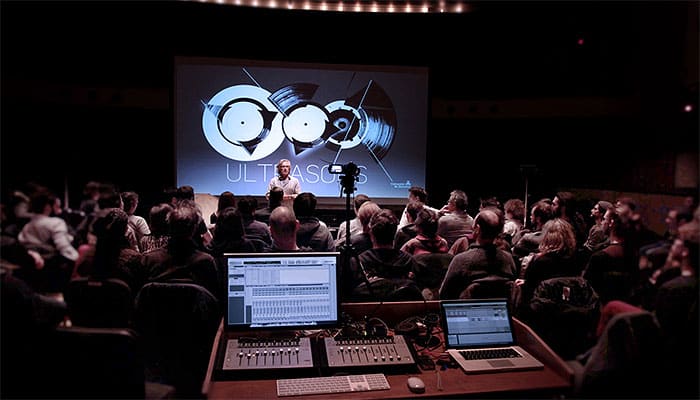
Solidly explosive is one way to describe the three days of concerts by students in the Digital Music program at
Université de Montréal. Ultrasons
is a student series. Only a few years ago, the Faculty of Music refreshed its electroacoustic-music program. The curriculum opened up to a broader practice of digital arts: installation, video music, software programming, new digital instruments and audiovisual performance. The basement of 200 avenue Vincent d’Indy has become a true artistic incubator for digital creatives. On April 26, 27 and 28, dozens of loudspeakers were placed around the stage in the large Claude-Champagne hall, a benchmark for acoustic excellence. Audience members could be immersed in torrents of music created by young and talented students. Their end-of-semester works were presented to the public as part
[vimeo id=”160513720″ width=”700″ height=”394″ autoplay=”no”]
of this
concert series called Ultrasons. This year’s Ultrasons edition was definitely more performative and gave free rein to the inventiveness of these creators. There were many favourites among the 31 works presented, totaling nearly five hours of music. Highlights included Alexis Langevin-Tétreault’s performance for guitar jack, a very promising work reminiscent of Martin Messier’s Field; Pierre-Luc Lecours’s work for drums, with fiercely effective stroboscopic effects; and Vincent Fliniaux’s powerful work for double bass. Among the curiosities was Renaud Bouliane’s Le Magicien, a humorous choreography in which the composer’s sounds and gestures reveal the contents of his hat, as well as Laurent Fortin-Fournier,

with a
cell phone. On the acousmatic side, designed for active listening in the dark, one remembers the half-hour mastodon composed by lecturers Georges Forget and Martin Bédard. Their work Prismasonor was solidly rooted in the electroacoustic tradition, with massive gestures while drawing on techno-trance electronic music throughsynth
pads and
groovy rhythms. The program also included two installations: a giant robotic carillon by François “Kathrin” Lagacé and a gastronomic audiovisual

In short, Ultrasons was a remarkable series that allowed the public to discover the emerging approaches of these talented young Montréal artists.
Similar posts
Culture and Creativity
read the article
Mois Numérique Jeunesse: The Program Continues!
Mois Numérique Jeunesse continues with a new week of activities focused on discovery and exploration. Under the theme “Your culture, your identity!”, the program mobilizes youth and the general public around the role of...
Culture and Creativity
read the article
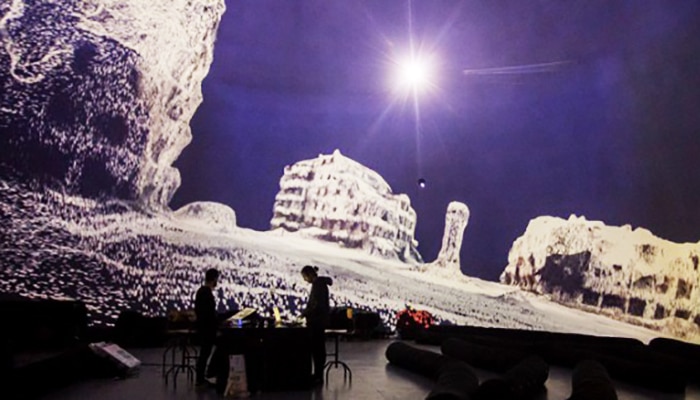
Corps-Espaces at the SAT
Corps-Espaces at the SAT invites audiences to experience the body, space and technology through immersive creation. Presented in the unique environment of the Société des arts technologiques, the project explores how bodies...