


Soleil: musicality in everyday life
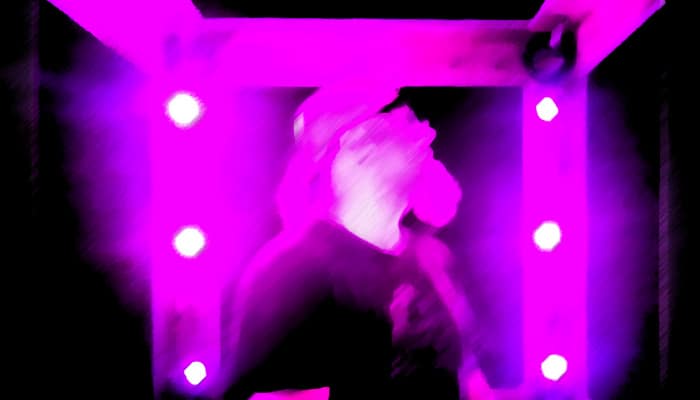
On Tuesday, May 20, 2014, I had the privilege of previewing Soleil, a work by Jean-Ambroise Vesac at the Maison culturelle et communautaire de Montréal-Nord. The work is free to visit from
today until June 22, 2014, as part of the Biennale internationale d’art numérique. It is an audio-luminous work, immersive and interactive, with electronic and software components.
Soleil takes the form of a square box closed on every side except underneath and raised on tall legs so a user can slip inside. Jean-Ambroise Vesac first invited me to put on glasses he had made. I entered without hesitation into the sound and visual universe of the piece. I quickly noticed that my movements inside the box—turning around or tilting my head—had an effect on the sounds, which became spatialized and created new sound compositions. I felt as if the

following me at all times. The flashes of light made me lose my bearings and forced me to follow my sound instinct to understand my position.
The atmosphere of Soleil felt like everyday life: children talking or laughing, sounds of skateboards or basketball, even a “there” from Jean-Ambroise Vesac’s voice. The more I moved, the more intense the sound became, until it turned grainy like a television with no signal. When I stopped moving, I could enjoy the ambience of wind in a park or a basketball game.
My main interest was understanding how Jean-Ambroise divided the four sides of the square box into distinct atmospheres and controlled multiple sound compositions. By associating each atmosphere with one side, I could eventually control the compositions and imagine myself as a real composer. The glasses contain a gyroscope, often used in scale models such as remote-control cars. In the installation, its data are captured and integrated into Max/MSP. This allows the artist to know remotely whether

user has moved a little, a lot or enormously, and whether they have turned. He links that data to the sound atmospheres arranged in the software.
Soleil therefore combines four channels, four tracks, one landscape, one layer of loops and noises, and five banks of twelve sounds. Jean-Ambroise’s research focuses on subjectivity. After several prototypes and software versions, he realized how important it is for users to feel stabilized in such an environment. He seeks a balance between immersion and interaction, as close to

as possible. His work can be summed up as the meeting between the individual’s subjectivity and his own. Soleil refers to consciousness, in contrast to the moon as intuition, and the piece invites visitors to experience that mixture of subjectivity and awareness.
Similar posts
Culture and Creativity
read the article
Québec Digital Art in the Spotlight in New York
From October 22 to 24, the Québec Digital Art event will showcase Québec digital art in New York. The Conseil québécois des arts médiatiques unveiled the program on the event’s application, #QDANY. Several exhibitions will provide...
Culture and Creativity
read the article
When waste inspires: Milieux associés
Have you ever wondered what happens to your garbage bags on the sidewalk? Milieux associés examines that journey from an artistic perspective.