


Line Nault, 2012 and the Programmed End of the World
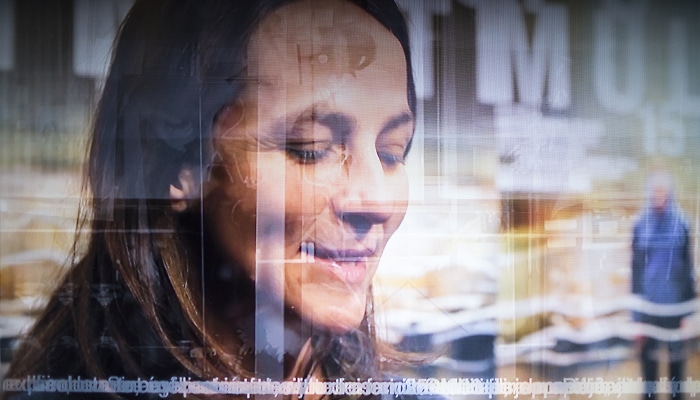
Remember the end of the world announced for December 21, 2012, which caused a great stir among populations around the globe. That news did not only bring anxiety; it also awakened a new creative breath in some artists. Artist Line Nault,who is currently exhibiting her work entitled 2012 at the Maison de la culture du Plateau-Mont-Royal as part of the Biennale d’art numérique,has interpreted that news in a very personal way.
Line Nault wondered what it would look like to bear witness to the life of a contemporary woman and artist, and how to magnify her days so that they would become part of her story. 2012 is therefore an open book on Line Nault’s life, inviting visitors to explore each memory and each page of the
artist’s diary.
2012 by
Line Nault. I had the opportunity to visit the work and speak with Line Nault about her interactive creation. First I will explain how 2012 is built, then help you better understand the material and interactive components of the piece.

2012 is presented in a dark room with a large screen at the back. At the entrance, a line marked with dates from the year 2012 is attached to the floor and leads to the front of the screen. On the left side of the room, three benches allow visitors to contemplate the work passively. In my case, the line of dates on the floor piqued my curiosity so much that I instinctively followed it. Once in front of the screen, a clicking sound was heard and a vertical bar appeared before me. Within this vertical section, the image and the scrolling text at the bottom of the screen became clear. Then, as I moved from left to right in front of the screen, the bar followed me and allowed me to decipher the image and the text more fully. What I did not immediately realize was the scale of the visual field before me and the full connection between writing,

image and my interaction with the work.
Although the interaction remains simple in gesture, the information revealed by the interactor is considerable. To create the visual content, Line Nault filmed herself in short capsules every day for 356 days until December 21, 2012. Alongside these capsules, the artist wrote a few lines each day in a journal in order to match the visual material with a kind of intimate diary. Each capsule, attached to a specific day, was then arranged in eight video layers placed one above the other. The transparency effect comes from this superimposition process, which allows viewers to see eight videos simultaneously and to discover all kinds of compositions straight from their imagination. 2012 therefore presents an open diary of the artist Line Nault through a visual and typographic process, without forgetting interactivity. Everything seems mixed and confused when the spectator remains inactive. However, the purpose of the experience is to encourage the user to stand in front of the screen so that a Kinect mounted on the ceiling can detect them. With the help of Alexandre Burton, an artistand digital luthier at Artificiel, Line Nault devised a very simple but effective interaction.
Thanks to
the Kinect’s infrared detection process, it can distinguish several physical presences within a certain area. The camera’s detection zone is about twelve feet, the width of the screen. After detecting the user, the Kinect sends the person’s spatial values to the Max/Msp program, allowing the software to know whether the user is near, far, more to the left or to the right in relation to the camera. This is what enables the vertical bar to move fluidly in front of a user. Also, the closer the person comes to the screen, the more they scroll through the video clips and choose the one that interests them. If someone wants to land on Line Nault dancing, they simply move forward, watch the videos scroll until the chosen one appears, and step back at the right moment to select it. Once again, the same information sent by the Kinect is used by the computer program to create this interaction. Despite the simplicity of the interaction, Line Nault has made the experience of freely jumping through her life instinctive and pleasant.
2012 by Line Nault
is available free of charge until June 8 as part of #BIAN2014. Want to learn
more about Line Nault and her work 2012? Here is Mois Multi, from Productions RectoVerso, in which the artist took part for the15th edition.
[youtube id=”b7FtNNRIWWs” width=”640″ height=”360″ autoplay=”no”]
Similar posts
Culture and Creativity
read the article
Art and Artificial Intelligence: Artistic Explorations in Montréal
Curated by Erandy Vergara, Art and Artificial Intelligence: Artistic Explorations in Montréal examines how artists engage with artificial intelligence beyond the utopian and dystopian futures often imagined by popular culture. The curatorial project begins...
Culture and Creativity
read the article
Montréal en lumière: Digital in the Spotlight
There is only one weekend left to warm up under the luminous rays of the 16th edition of Montréal en lumière. Digital technology is increasingly present at this extraordinary winter festival...