


Could the End of the Internet Be Coming Soon?
Eastern Bloc will begin2017 with this question, through an exhibition on the possible collapse of the World Wide Web.Bringing together five works, The Dead Web –La Fin, held from January 19 to February 15, invites the public to reflect on a form of post-web world. The idea of a general collapse of the network, as early as 2023, was raised during a scientific symposium organized in 2015 by Britain’s Royal Society onthe Internet capacity crunch. Following media coverage of that news, curator Nathalie Bachand wanted to gather artistic proposals that imagine this post-web era and ask how to occupy this hypothetically endangered space. What form would the expression of power, certainly economic and by default political, both dematerialized and delocalized, take if the machine were unplugged? And what is still possible to do or say while waiting? Artists Frédérique Laliberté with Web Infinitisme.com Forever A Prototype; Grégory Chatonsky and Dominique Sirois with Mémoires Éteintes III; Julien Boily with the painting Memento Vastum; Julie Tremble with the 3D animation BPM 37093; and the duoProjet EVA, Simon Laroche and Etienne Grenier, withL’Objet de l’Internet, begin this reflection. TheDead Web – La Fin: the works. Infinitisme.com Forever A Prototype by Frédérique Laliberté
is an endlessly in-progress web project, an autonomous
collage machine that generates semi-random virtual

compositions by drawing from a bank of categorized and classified digital files: images, sounds, animated gifs, videos, text and more. Each visit produces a series of ephemeral constructions based both on the rigidity of archival systems and on the casualness of chance. Frédérique Laliberté is drawn to collage, bugs, video, tinkering, programming, hacking, writing, screenshots, discourse, the Internet and reuse. She
develops an ethical and philosophical reflection on accumulation and on the idea of using what already exists. Transfiguration is at the heart of her approach, allowing her to create in parallel with the intention of producing nothing. Mémoires Éteintes by Grégory Chatonsky and Dominique Sirois. The third iteration of an installation suggesting the end, and above
all
the discovery, in the archaeological sense, of

a world as we knew it through the exhumation of still-readable Internet servers, Mémoires Éteintes III evokes our own extinction as a human race and imagines the future of our digital remains. Born in Paris in 1971, Grégory Chatonsky founded Incident.net in 1994, one of the first net-art platforms, and
during those early years developed variable fictions that intertwined affects and technologies by diverting flows from the network. Internet quickly became the main medium of his activity, both as a support for distribution and as a source of inspiration translated afterward onto other digital or analogue supports. Dominique Sirois’s practice takes the form of installations composed of sculptures, videos, sounds
and printed images, and toucheson three fields of interest: value and surveillance, economy and affects, and ruins and obsolescence. Her projects have been presented in many artist-run centres in Canada. Memento Vastum by Julien Boily speaks of lost memory: loss of know-how, but also of older knowledge immediately
replaced by new knowledge, often

in the form of information or data. It is a recursive dynamic that constantly accelerates. This notion of remains intersects with planned obsolescence and vanity. If, in the 17th century, the mirror was a recurring element in vanitas compositions, still lifes evoking the ephemeralcharacter of humanity, today our electronic devices and computer tools could fulfill the same function, with the Internet acting like a one-way mirror. Inspired by the work of old masters from the golden age of painting, Julien Boily diverts
the pictorial codes of that period to represent contemporary scenes. He givesup any search for formal invention and uses painting for its initial functions of representing reality. The painting then participates in the work as a semantic element in itself, on the same level as what is represented. BPM 37093 by Julie Tremble is a short 3D animation that tells, whether fiction
or
reality, an uncertainty intentionally left

open, the death of a star and the slow transformation of its materiality. BPM 37093 is a star that was very similar to the sun and is now dead. Scientists discovered that, as it died, the star was almost entirely transformed into diamond, as the sun will be in billions of years. The highly accelerated temporality of this star’s death, 1 minute 14 seconds for millions of years, questions duration and instantaneity, transformation and our representations of the world. Nourished by cinema, visual arts, literature and philosophy, Julie Tremble’s
work focuses mainly on the role narration plays in our experience of the world. In recent years she has explored the figure of the explosion through experimental fictions and digital animations. L’Objet de l’Internet by Projet EVA, Simon Laroche and Etienne Grenier. What better
than a monument to testify to past glory? With

L’Objet de l’Internet, an installation evoking the idea of a mausoleum for the end of the web, visitors are projected into a dystopian future in which only traces of a few still artificially animated selfies remain on social networks as a resonance. Condemned to sterile solipsism, they move in the sidereal void of the end of the Internet. Formed by Simon Laroche and Etienne
Grenier, both artists, interactive-media designersand teachers,Projet EVA is a collective that has produced digital art installations and performances internationally since 2003. Its works address themes of loss and restriction and explore robotics, electronics, video and audio. The Dead Web – La Fin, Eastern Bloc production and exhibition centre, 7240 Clark. January 19 to February 15, 2017. Opening: January 19,
2017,
6 p.m. to 9 p.m.
Gallery hours: Tuesday to Sunday, 12 p.m. to
[checklist icon=”dribbble” iconcolor=”#e83565″ circle=”yes”]
- 5 p.m. For full details, consult
- the related page, event page, exhibition page and
- partner links provided here.
[/checklist]
Similar posts
Culture and Creativity
read the article
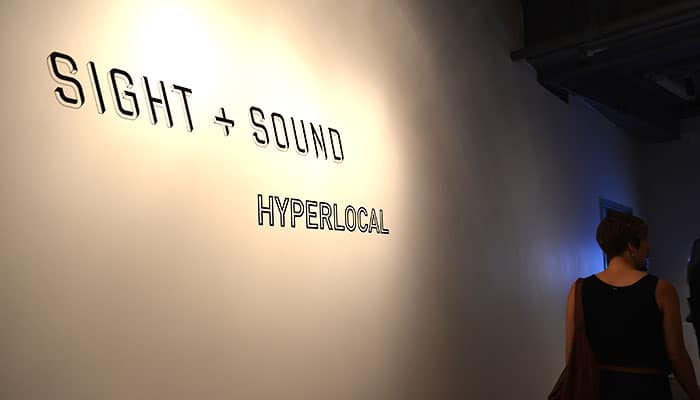
Sight & Sound, the Committed Festival
The Sight & Sound International Digital Art Festival is in full swing until May 24. At the heart of Printemps numérique, the seventh edition explores the question of the hyperlocal that crosses borders. Sight & Sound...
Culture and Creativity
read the article
Looking Back at the 3rd Edition of Mois Numérique Jeunesse
From February 1 to March 6, 2022, Mois Numérique Jeunesse took place under the theme of transparency. Nearly 20,000 young people benefited from activities offered by many partner organizations across Québec. The third edition...