


Elektra 2016: Fiendishly Good!
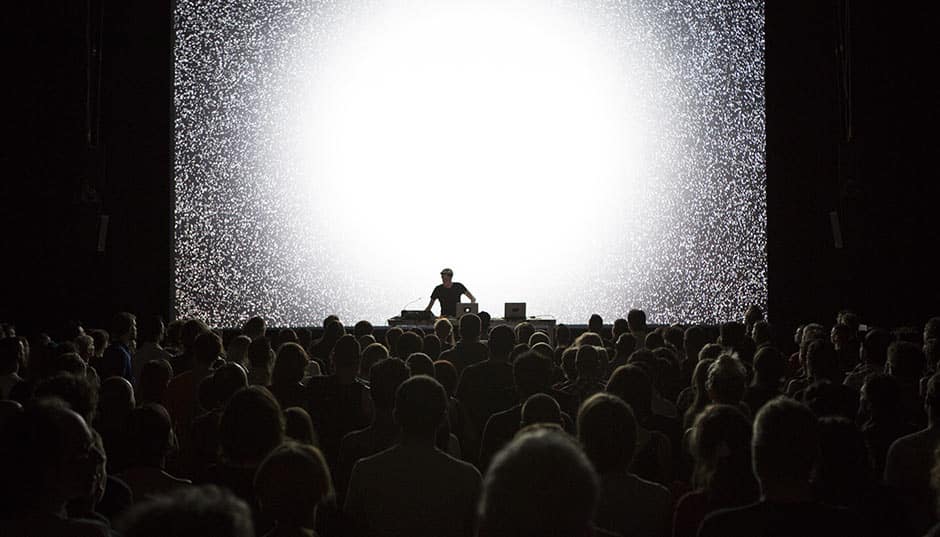
Breathtaking. That is the first word that comes to mind to describe my Elektra evening of June 3. No joke, with the last two performances of the night, it wasmind-blowing.
An evening with Elektra.
In the immense space of the private foundation Arsenal Artcontemporain, located on William Street, visitors could move from work to work, admiring Eternity by Nicolas Baier, Ugo Rondinone’s enamel-and-aluminum tree, or the plethora of art objects made by machines, for machines. Indeed, in addition to the performances offered by Elektra and the few works acquired by the foundation, visitors could see the AUTOMATA exhibition organized by the Biennale internationale d’arts numériques. Since that exhibition deserves a post ofits own, let us focus instead on two of the evening’s Elektra performances: Vertex by Saint-Denis / Piché and Inferno by Vorn / Demers. Vertigo with Vertex. Once
inside the immense hangar
used for the show, one quickly notices a colossal form placed on a huge pedestal draped in black. A true sound machine, Vertex is both architecture and instrument. This 4 x 4 matrix is in fact a cube made of 16 rods on which loudspeakers are mounted. Taking up the idea of the Leslie cabinet, its speakers can spinaround themselves and move up and down along their axes, imitating shapes like the flight of birds. From this machine comes dense electronic music, focused more on timbre than melody, while the LED lamps placed on the speakers, moving in or out of sync, form a true choreography of light. During one of the rare moments of darkness in the performance, the surprisingly organic movement of the counterweight system can be glimpsed in the half-light. We do not know what the composers and the instrument have in store for us next, but we are eager to find out.

The bewitching
Inferno. Without question, Inferno was the sensation of the moment. During this participatory performance, 24 people could put on one of the exoskeletons created by Bill Vorn and Louis-Philippe Demers. These robotic arms were attached directly to the bodies of the participants, who were then subjected to a preprogrammed choreography. Visitors, in a way prisoners of these metal claws, became like puppets at the mercy of the artists, who made them perform dance movements. After a few moments of uncertainty, however, the participants gave in to temptation and surrendered to the delirium of being possessed by an unknown force. An infernal image? Absolutely. Unable to resist myself, I jumped at the opportunity to put on one of these strange suits, and one must admit that signing the waiver feels like selling one’s mortal soul to the devil. With this mass of metal on your shoulders, you feel ready to go to war. After the suspense of a long musical introduction, you are shaken by the robotic structure you are wearing and, with no choice but to align yourself with the will of the machine, you begin to dance, as if in a trance, living the pleasant opposite of eternal torment, and you lose yourself in the music’s huge, fully charged rhythms. Inferno, entertainment of the future? The future can go boil an egg. With technological pleasure as thrilling as Inferno, the present suddenly seems far more interesting. After an evening like this, one wonders how to wait another year for the next Elektra series. Challenge accepted. Inferno –
Similar posts
Culture and Creativity
read the article
MTL connecte: A First Digital Week Marked by Boldness and Cross-Pollination of Knowledge
MTL connecte’s first Digital Week was marked by boldness and the cross-pollination of knowledge. The event brought together participants from Montréal and abroad around thematic pavilions, conferences, panels, workshops, visits and networking activities. By...
Culture and Creativity
read the article
MUTEK: A Spirit of Discovery
One hundred and twenty artists from 20 countries played on MUTEK's playground over the past few days. The 80 projects presented for the 17th...