


AUTOMATA: The Art of Machines
At Arsenal Art Contemporain, on William Street, the Biennale internationale d’art numérique decided to present AUTOMATA: art made by machines for machines. The Arsenal, a temple
for art. As in a
museum, the Arsenal is a place with the aura of a temple. Immense white walls rise toward a ceiling about ten metres high. Visitors move among works placed on surfaces and on altar-like plinths scattered throughout 50,000 square feet of exhibition space, roughly the equivalent of a football field. This grandiose character echoes the scale of the works themselves, which breathe in the middle of the space instead of being crushed into a room that is too small, and one can observe each element of the art objects in isolation. AUTOMATA: living robots. In AUTOMATA, more
than forty works take us
further into interactive art. Here, the works are not only meant to be contemplated. They are no longer motionless, placed on a white wall as if they had always been there. Now the art objects are alive. They interact with us. In The Value of Art by Laurent Mignonneau and Christa Sommerer, the boundary is blurred between what is and what is not the work. Is it the painting of a cat, the system that evaluates the time spent by the viewer contemplating the work, or the invoice indicating that the painting’s value rises by one euro for every ten seconds of viewing? Perhaps the work is the entire imagined process of evaluating art. We are in the same order of ideas with 5RNP Étude humaine #1 by Patrick Tresset. A system made up of five computers controls a camera and a pen articulated by a robotic arm. These five robots then sketch a person’s face. The process is quite long, 30 to 40 minutes, but the result is remarkable. Once again, it is clearly not the drawing that is the work, nor even the robotic system, but the activation of that system. The artist instead speaks of a theatrical robotic installation to describe this work, which comes very close to performance. In this work, as in many others shown in AUTOMATA, one senses the inverted echo of a future that is gradually reaching us: a reality in which machines would produce art. Some may remember the sequence in the film adaptation I, Robot, where onerobot makes a sublime drawing. Could machines one day develop artistic sensitivity? Sceptics may perhaps be confounded. And a few gems.
Of course, it
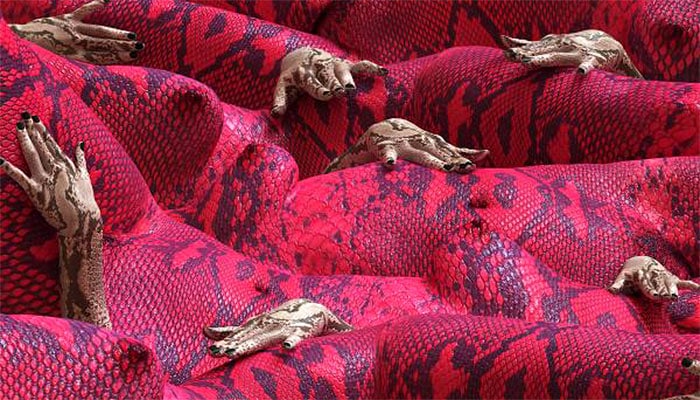
is worth mentioning some of the works that, while not interactive, remain highly attractive. Think of the sensuality of the work by South Korean artist Kim Joon, based on tattoo taboos that are important in his country. This moving painting is in fact a video mosaic in which black-marbled hands caress glossy skin made of snake scales. The Loops of Relation series is a video installation by Nelmarie du Preez. Combined with a recording of the performance To Stab,these powerful videos feature the artist and her computer as members of the collective Du Preez / Gui. When Gui’s mechanized arm holds a bow, du Preez draws the string with the arrow pointed toward herself, literally placing herself in mortal danger, an explicit reference to Marina Abramović’s Rest Energy. This interaction between the artist and the computer, which is in a sense her robotic reflection, leaves us thinking about human identity in the computer age. Among the most imposing works, one naturally thinks of the 205 sound boxes by artist Zimoun. After entering through an improvised opening, we find ourselves in a kind of silo made of cardboard boxes, on which a small ball bounces thanks to a motor system. The result is a low pandemonium, a kind of heavy hum that invades the space and echoes the industrial look of the Arsenal. Closing your eyes, you can even imagine being a worker in a gigantic factory. We could also speak of the works of Jean-Benoît Lallemant or those of Le Pang, whose minimalism contributes to their captivating force, but really the simplest thing is simply to go there and appreciate the richness of the entire AUTOMATA
exhibition. BIAN and AUTOMATA exhibition website. AUTOMATA exhibition:
art made by machines for machines. 3rd Biennale internationale d’art numérique, until July 3, 2016. Arsenal, 2020 William Street. Seven minutes on foot from Georges-Vanier metro station.
Similar posts
Culture and Creativity
read the article
Creative Montréal, Where Art Makes the City Vibrate
Since February 19, Place des Arts has been vibrating to a very special rhythm: that of creativity and digital technology. In fact, the most inspiring vibration comes from the heart of Place...
Culture and Creativity
read the article
QUÉBEC DIGITALE ROMA
On October 9, the ELEKTRA team was in Rome for the official opening of QUÉBEC DIGITALE ROMA, a showcase of Québec digital artists presented as part of Romaeuropa and the Digitalife Luminaria exhibition until December 6....